If you’ve ever opened a chat and seen someone say “he’s MIA” or “she went MIA,” you might have paused for a second. It sounds serious, almost military—but in texting, it has a very different emotional weight.
In modern digital communication, MIA meaning in text usually refers to someone being “missing in action” from conversations, social media, or real-life presence. It’s not always dramatic, but it often signals distance, silence, or emotional withdrawal.
People search this term because it appears everywhere—Instagram captions, TikTok comments, WhatsApp chats—and the meaning can shift depending on tone. Sometimes it’s funny. Sometimes it’s concerning. Sometimes it feels personal.
Let’s break it down in a clear, human way so you fully understand what it really means in every context.
MIA Meaning in Text – Quick Meaning
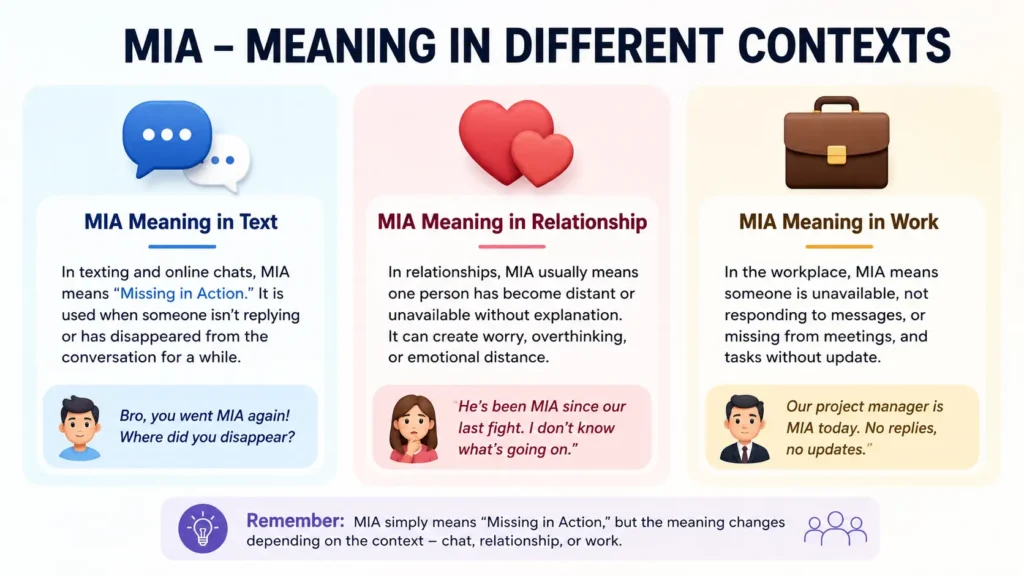
In texting and social media, MIA stands for “Missing In Action.”
It is used when someone is:
- Not replying to messages
- Not active on social media
- Disappearing from group chats
- Avoiding communication for a while
Common examples:
- “She’s been MIA all week.”
- “Bro went MIA after the argument.”
- “I was MIA, sorry I didn’t reply.”
It can be serious, casual, or even playful depending on tone.
Origin & Background
The phrase MIA originally comes from the military, where it meant soldiers who were “Missing In Action” during war or conflict.
Over time, internet culture adopted the term and softened its meaning. Instead of battlefield situations, it began to describe digital silence and social disappearance.
Social media platforms like Instagram, Snapchat, and TikTok helped push it into everyday slang. By the early 2010s, people were using it casually in DMs and captions.
Today, it’s part of global internet vocabulary, used by Gen Z and Millennials alike.
MIA Meaning in Relationship
In relationships, MIA carries emotional weight.
It often means one partner has become distant or unavailable without explanation.
Examples:
- “He went MIA after we argued.”
- “She’s MIA and I don’t know what happened.”
It can indicate:
- Emotional withdrawal
- Ghosting behavior
- Need for space
- Avoidance after conflict
In healthy communication, being MIA without explanation can create confusion or anxiety. That’s why it often appears in breakup stories or emotional discussions.
MIA Meaning in Instagram
On Instagram, MIA usually means someone is inactive or not posting.
Common usage:
- “MIA from Instagram lately”
- “She’s been MIA, no stories, no posts”
It can also be used playfully:
- “I went MIA for a mental health break 😭”
Influencers and creators sometimes use it to explain breaks from content creation or burnout.
Mia Meaning TikTok
On TikTok, “MIA” is heavily used in captions and comments.
It often appears in:
- Relationship story times
- Glow-up or disappearance jokes
- Mental health breaks
Example captions:
- “Went MIA but I’m back better than ever”
- “POV: your bestie goes MIA after getting a boyfriend”
TikTok gives it a dramatic or humorous tone depending on context.
MIA Meaning in English
In standard English, MIA literally means “Missing In Action.”
It is:
- An acronym
- Originally military terminology
- Now adapted into informal language
In formal writing, it still refers to missing persons in conflict situations, but in everyday English it is mostly slang.
MIA Meaning in Work
In workplace communication, MIA is used to describe someone who is unavailable or unresponsive.
Examples:
- “He’s MIA from the meeting.”
- “The designer has been MIA on email updates.”
It can signal:
- Missed deadlines
- Lack of communication
- Absence from tasks or teamwork
However, in professional settings, it can sound informal or slightly critical, so it’s used carefully.
Mia Slang in a Sentence
Here are natural ways it appears in conversation:
- “Don’t go MIA on me again.”
- “She’s been MIA since yesterday’s argument.”
- “I thought you were MIA, glad you replied.”
It often carries emotion—concern, humor, or frustration.
Mia Urban Dictionary
On Urban Dictionary, MIA is defined in multiple emotional and slang-heavy ways, such as:
- Disappearing without explanation
- Ignoring messages intentionally
- Taking a break from social life or internet
Some entries also describe it humorously as:
- “When your friend falls off the face of the earth but still posts stories”
It reflects how flexible and context-driven internet slang can be.
Mia Definition KATSEYE
In pop culture, especially with groups like KATSEYE, “MIA” can appear in fandom discussions or comments when fans say a member is “MIA” during promotions or content drops.
In this context, it doesn’t mean disappearance in a serious sense. It usually means:
- A member is not in recent content
- They are less visible in promotions
- Fans are waiting for updates
It becomes part of fan language and speculation.
Real-Life Conversations (MANDATORY)
WhatsApp Chat
Person A: Where is Sara?
Person B: No idea, she’s been MIA since yesterday
Person A: Hope she’s okay, she didn’t reply to anyone
Instagram DM
Person A: You posting again or still MIA?
Person B: Still MIA lol, needed a break from everything
Person A: Fair, come back when you’re ready
TikTok Comment Section
Person A: Why did you disappear?
Person B: I went MIA for mental health, I’m back now
Person A: We missed you fr 😭
Text Message
Person A: Bro you MIA or what?
Person B: Sorry, phone died and I was busy
Person A: Thought you ghosted me 😭
Emotional & Psychological Meaning
When someone goes MIA, it often reflects more than just silence.
It can mean:
- Emotional overload
- Need for space
- Avoidance of conflict
- Social exhaustion
People use “MIA” because it feels softer than saying “ignored me” or “ghosted me.”
For example, someone might disappear after a stressful week, not because they don’t care, but because they’re overwhelmed. In digital culture, silence is quickly noticed, so “MIA” becomes a shorthand for emotional absence.
Usage in Different Contexts
- Social Media: inactivity, break from posting
- Relationships: emotional distance or ghosting
- Work: missing tasks or meetings
- Casual chats: playful disappearance
Tone matters. In friendships it can be funny, but in relationships it can feel serious.
When NOT to Use It
Avoid using “MIA” when:
- Someone is dealing with serious personal issues
- Someone is hospitalized or facing emergencies
- In formal HR or legal communication
- When it could sound dismissive or insensitive
It may unintentionally trivialize real situations.
Common Misunderstandings
Many people think:
- It always means ghosting (not true)
- It is always negative (it can be neutral)
- It only applies to relationships (it applies everywhere)
Context decides meaning.
Comparison Table
| Term | Meaning Intent | Usage Intent | Example Intent | Comparison |
|---|---|---|---|---|
| What does MIA mean | Missing in action | Explain absence | “He’s MIA” | vs ghosting |
| How to use MIA | Describe silence | Informal chats | “She went MIA” | vs inactive |
| Examples of MIA | Real usage | Context clarity | “MIA for days” | vs ignoring |
| MIA vs Ghosting | Partial vs complete disappearance | Relationship tone | “MIA but replies later” | vs permanent cutoff |
Key Insight:
MIA is softer than ghosting—it suggests temporary disappearance, not always intentional cutting off.
Variations / Types (8–10)
- MIA meaning in text: missing from chats or replies
- MIA in chat: inactive in conversation
- MIA slang: casual disappearance term
- MIA abbreviation: Missing In Action
- MIA in Instagram: not posting or active
- MIA in relationship: emotional distance
- MIA in work: unavailable or unresponsive
- MIA in TikTok: content break or trend caption
- MIA urban slang: internet disappearance term
- MIA casual use: playful absence
How to Respond When Someone Uses It
Casual replies:
- “Lol I was just busy”
- “Yeah I disappeared for a bit”
Funny replies:
- “I survived my MIA arc 😭”
- “Back from the shadows”
Mature replies:
- “I needed some time offline”
- “Sorry for being unavailable”
Respectful replies:
- “Thanks for checking in, I’m okay now”
- “I appreciate your concern”
Regional & Cultural Usage
- Western culture: used casually in texting and work slang
- Asian culture: often used in social media captions and fandoms
- Middle Eastern culture: less formal usage, more chat-based slang
- Global internet: widely understood across platforms
- Gen Z: playful, emotional, meme-driven
- Millennials: more literal and contextual
Is It Safe for Kids?
Yes, MIA is generally safe slang, but context matters.
It is harmless in casual use, but children should understand:
- It can relate to emotional situations
- It should not be used to joke about serious disappearances
FAQs
What does MIA mean for Gen Z?
For Gen Z, MIA is a casual slang term meaning someone has disappeared from chats, social media, or daily online activity. It is often used humorously when someone stops replying or goes offline for a while. In Gen Z culture, it can also signal taking a mental health break or simply being busy with life.
2. What is MIA in social media?
On social media, MIA describes a user who is not posting, commenting, or engaging for a period of time. It is commonly seen in captions or comments like “she’s been MIA lately.” The term is flexible and can mean anything from a short break to long-term inactivity.
3. What does MIA mean in love?
In love or relationships, MIA usually means one partner has become emotionally or physically distant without clear communication. It can create confusion, worry, or overthinking in the other person. Sometimes it indicates a need for space, but it can also be linked to ghosting behavior.
4. What does MIA mean in UK slang?
In UK slang, MIA keeps its original meaning of “Missing In Action,” but is used more casually in everyday conversations. People use it to describe friends who stop replying or disappear from group plans. It is not offensive and is commonly used in a light, joking tone.
5. What does MIA mean in texting?
It means someone is missing or not replying in chats or online activity.
6. Is MIA the same as ghosting?
Not exactly. MIA can be temporary, ghosting is usually permanent.
7. Why do people go MIA?
Because of stress, busy schedules, or needing digital breaks.
8. Is MIA rude to say?
Not always, but it depends on tone and situation.
9. Can MIA be positive?
Yes, it can mean taking a healthy break from social media.
Conclusion
MIA in text is more than just slang—it reflects how people behave in today’s fast digital world. It describes moments when someone disappears from chats, social media, or daily communication, often without explanation. While it can feel confusing or emotional, it is usually temporary and not always negative. Understanding its meaning helps avoid misunderstandings in relationships, friendships, and online interactions. In modern communication, MIA simply shows the human need for space, rest, and occasional silence.