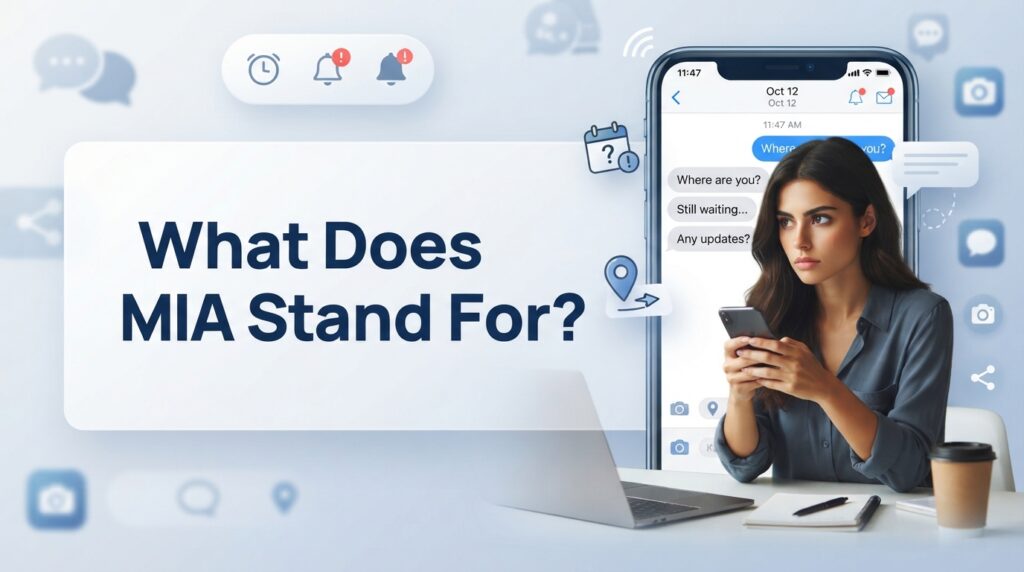
If you’ve ever received a message saying, “You’ve been MIA lately,” or seen someone post “Sorry, I’ve been MIA,” you may have wondered: what does MIA stand for? While the acronym originally came from the military, it has evolved into one of the most commonly used expressions in texting, social media, relationships, and everyday conversations.
Today, MIA doesn’t always refer to its original meaning. Instead, it often describes someone who has disappeared from conversations, stopped replying, or simply taken a break from social life. Whether you’re chatting on WhatsApp, scrolling through Instagram, or reading TikTok comments, understanding MIA helps you avoid confusion and communicate more naturally.
In this guide, you’ll learn the meaning of MIA in different contexts, where it came from, how people use it online, and when it’s appropriate—or inappropriate—to use it.
What Does MIA Stand For? – Quick Meaning
MIA stands for Missing In Action.
Originally, it referred to military personnel whose whereabouts were unknown during combat. Today, the phrase has expanded far beyond the military.
Modern meanings include:
- Someone who hasn’t replied to messages.
- A person who disappeared from social media.
- Someone who hasn’t been seen for a while.
- A friend taking a break from communication.
Examples
“You’ve been MIA all week. Is everything okay?”
“Sorry, I’ve been MIA because of exams.”
“She went MIA after deleting Instagram.”
Origin & Background
The phrase Missing In Action (MIA) became widely recognized during wartime, especially during World War II and the Vietnam War. It described soldiers who could not be confirmed as alive or deceased after military operations.
As internet culture grew, people borrowed the phrase in a much lighter way. Instead of describing missing soldiers, MIA began referring to anyone who suddenly disappeared from conversations, online communities, or social events.
Social media accelerated this shift. Platforms like Instagram, TikTok, Snapchat, and WhatsApp made it easy to notice when someone stopped posting or replying. Today, saying someone is “MIA” usually means they have gone quiet—not literally gone missing.
What Does MIA Stand for in Pakistan
In Pakistan, MIA is commonly understood with the same meaning as elsewhere: Missing In Action or simply “missing” from conversations.
Young people frequently use it in texting:
- “Bro, where were you? You went MIA.”
- “Sorry, exams made me MIA.”
Outside internet slang, most Pakistanis recognize its original military meaning through news or historical references.
What Does MIA Stand for in Chat
In online chats, MIA simply means someone has disappeared from the conversation.
Examples include:
- Not replying for days.
- Suddenly leaving a group chat.
- Ignoring messages temporarily.
- Being inactive online.
It usually isn’t considered offensive unless used sarcastically.
What Does MIA Stand for in English
In standard English, MIA officially means Missing In Action.
However, dictionaries also recognize its informal use meaning:
- Absent
- Missing
- Unreachable
- Temporarily unavailable
This informal meaning has become far more common in everyday English.
What Does MIA Stand for in Medical Terms
In medicine, MIA may have different meanings depending on the specialty.
Some examples include:
- Minimally Invasive Approach
- Medical Insurance Authorization
- Medical Information Assistant
Unlike texting slang, medical abbreviations depend entirely on the healthcare setting.
MIA Meaning in Relationship
Relationships are one of the most common places where MIA appears.
Examples include:
- Someone suddenly stops texting.
- A partner becomes emotionally distant.
- A crush disappears without explanation.
- A friend withdraws for personal reasons.
Example:
“My boyfriend has been MIA for three days.”
This doesn’t necessarily mean the relationship is over—it simply means the person has become temporarily unavailable.
What Does M.I.A Stand for in KATSEYE
Among KATSEYE fans, M.I.A generally refers to the song title rather than the traditional military meaning.
Depending on fan discussions, it symbolizes:
- Feeling emotionally distant.
- Being lost.
- Personal struggles.
- Temporary absence.
The emotional meaning fits the song’s overall theme.
MIA Meaning in Instagram
On Instagram, MIA usually means someone has disappeared from the platform.
Examples include:
- Not posting Stories.
- Taking a social media break.
- Deactivating an account.
- Not replying to DMs.
Example:
“Sorry I’ve been MIA lately. Needed a mental health break.”
What Does I Go MIA Mean
“I go MIA” means:
“I disappear for a while.”
People often use it when they’re:
- Busy with work.
- Studying.
- Feeling overwhelmed.
- Taking a digital detox.
Example:
“Whenever life gets stressful, I go MIA for a few days.”
Real-Life Conversations
Person A: Hey, everything okay? You’ve been MIA.
Person B: Yeah, work has been crazy. Sorry for disappearing.
Instagram DM
Person A: Thought you unfollowed everyone!
Person B: Nope 😂 Just went MIA for a social media detox.
TikTok Comments
Person A: Where have you been?
Person B: Sorry lol… I’ve been MIA because of finals.
Text Message
Person A: You vanished!
Person B: I know 😭 I’ve been totally MIA lately.
Emotional & Psychological Meaning
When someone says they’re MIA, it often reflects more than physical absence.
Sometimes they’re overwhelmed.
Sometimes they need space.
Sometimes they simply don’t have the emotional energy to communicate.
Modern communication expects constant availability. Saying “I’ve been MIA” has become a gentle way to explain temporary silence without giving every detail.
Imagine a close friend who suddenly stops replying. Days later they apologize by saying they were MIA because they needed time to recover from stress. That short phrase communicates absence, honesty, and emotional vulnerability without requiring a long explanation.
Usage in Different Contexts
Social Media
People use MIA when taking breaks from Instagram, TikTok, Snapchat, or Facebook.
Example:
“I’m going MIA for the weekend.”
Friends & Relationships
Friends often joke about someone disappearing.
“You always go MIA after getting into a relationship.”
Work & Professional Settings
In informal workplaces:
“You’ve been MIA from Slack.”
Formal workplaces usually prefer:
- unavailable
- absent
- offline
Casual vs Serious Tone
Casual:
“I’ve been MIA lol.”
Serious:
“The rescue team still lists several individuals as MIA.”
Context completely changes the tone.
When NOT to Use It
Avoid using MIA:
- When discussing tragic missing-person cases.
- During military memorial conversations.
- In formal legal writing.
- If someone may misunderstand the humor.
Sensitivity matters because MIA has serious historical roots.
Common Misunderstandings
Many people think MIA only refers to soldiers.
Others assume it means ghosting forever.
Common misconceptions include:
- MIA always means someone ignored you.
- MIA means blocking someone.
- MIA equals breakup.
- MIA only applies online.
In reality, it usually describes temporary absence.
Comparison Table
| Search Intent | Meaning |
|---|---|
| What Does MIA Mean | Understand the definition and purpose |
| How to Use MIA | Learn correct situations to use it |
| Examples of MIA | See realistic conversations |
| MIA vs Ghosting | MIA is usually temporary; ghosting often implies permanent silence |
Key Insight
While both involve disappearing, MIA usually suggests temporary absence with the possibility of returning, whereas ghosting often implies intentionally ending communication without explanation.
Variations / Types
MIA meaning
Missing In Action or temporarily absent.
MIA in text
Someone hasn’t replied or disappeared.
MIA abbreviation
Short form of Missing In Action.
MIA slang
Used humorously for disappearing from social life.
MIA in chat
Inactive or not responding.
Going MIA meaning
Choosing to disappear temporarily.
Been MIA meaning
Absent for some time.
Why are you MIA?
Asking why someone disappeared.
MIA on Instagram
Inactive on social media.
MIA online
Offline or unavailable digitally.
How to Respond When Someone Uses It
Casual Replies
- “Glad you’re back!”
- “No worries!”
- “Missed you.”
Funny Replies
- “Thought aliens got you!”
- “Welcome back from your secret mission.”
- “Mission accomplished?”
Mature Replies
- “Hope you’re doing better.”
- “Take all the time you need.”
Respectful Replies
- “Thanks for checking in.”
- “I’m here whenever you’re ready to talk.”
Regional & Cultural Usage
Western Culture
MIA is widely used in casual conversations to describe someone disappearing from social interactions.
Asian Culture
Young internet users frequently use MIA in English conversations, especially on social media.
Middle Eastern Culture
MIA is understood among English-speaking communities but is less common in everyday local-language conversations.
Global Internet Usage
Across Instagram, TikTok, Discord, WhatsApp, and Reddit, MIA almost always refers to temporary absence.
Gen Z vs Millennials
Gen Z often uses MIA humorously with memes and emojis.
Millennials typically use it more literally to explain being offline or busy.
Is It Safe for Kids?
Yes. MIA is generally safe for children because it simply means someone is temporarily absent. Parents should still explain its original military meaning and teach kids that context matters, especially when discussing serious real-world events.
FAQs
What does MIA stand for in texting?
In texting, MIA stands for “Missing In Action,” but it usually means someone has been absent, inactive, or hasn’t replied to messages for a while. It’s a casual way to ask why someone disappeared from a conversation or explain that you’ve been busy. For example, someone might text, “You’ve been MIA all week!” to check in with a friend.
What does it mean if you go MIA?
If you go MIA, it means you suddenly become unavailable or disappear from communication without giving regular updates. This could happen because you’re busy with work, school, personal issues, or simply taking a break from social media and messaging. In most cases, it suggests a temporary absence rather than ending contact permanently.
What does the slang MIA mean?
As slang, MIA refers to someone who has gone quiet, stopped responding, or hasn’t been seen for some time. It’s commonly used in conversations among friends, on social media, and in online chats to describe a temporary disappearance. The phrase usually carries a lighthearted tone, although it can also express concern if someone has been gone unexpectedly.
What is MIA in social media?
On social media, MIA means that a person has stopped posting, commenting, or interacting online for a period of time. People often use it when taking a digital detox, focusing on personal matters, or stepping away from platforms like Instagram, TikTok, or X. A common example is, “Sorry I’ve been MIA lately—I needed a break from social media.”
Does MIA always mean someone is ignoring you?
No, MIA does not always mean someone is ignoring you. Many people go MIA because they’re overwhelmed with work, studying, traveling, dealing with personal challenges, or simply taking time for themselves. While it can sometimes involve delayed replies, the term generally implies temporary absence rather than intentional avoidance.
Is MIA the same as ghosting?
Not exactly. MIA usually describes someone who disappears for a short time but may eventually return and explain their absence, whereas ghosting means cutting off communication completely without any explanation. The key difference is that going MIA is often temporary, while ghosting is usually seen as a permanent end to the conversation or relationship.
What does MIA stand for?
MIA stands for Missing In Action, but in everyday conversations it usually means someone has disappeared or become temporarily unavailable.
Is MIA a bad word?
No. It’s a neutral expression commonly used in texting and social media.
What does “I’ve been MIA” mean?
It means you’ve been absent, inactive, or not responding for a period of time.
Is MIA the same as ghosting?
Not exactly. MIA often suggests a temporary absence, while ghosting usually means ending communication without explanation.
Can MIA be used professionally?
In informal workplace chats, yes. In formal communication, words like “unavailable” or “absent” are usually more appropriate.
What does “go MIA” mean?
It means to disappear temporarily from conversations, social media, or daily interactions, often because of personal reasons or being busy.
Why do people say someone is MIA?
People use it to describe someone who hasn’t been seen, contacted, or active for a while without necessarily implying anything serious.
Conclusion
Understanding what does MIA stand for helps you recognize one of the internet’s most common expressions. Although it originally meant Missing In Action in military contexts, today’s digital world uses it to describe someone who has temporarily disappeared from conversations, social media, or daily communication. Whether you’re chatting with friends, responding on Instagram, or explaining your own absence, using MIA appropriately makes your messages feel natural and relatable. By knowing its history, emotional meaning, and modern usage, you can confidently understand—and use—MIA in almost any conversation.