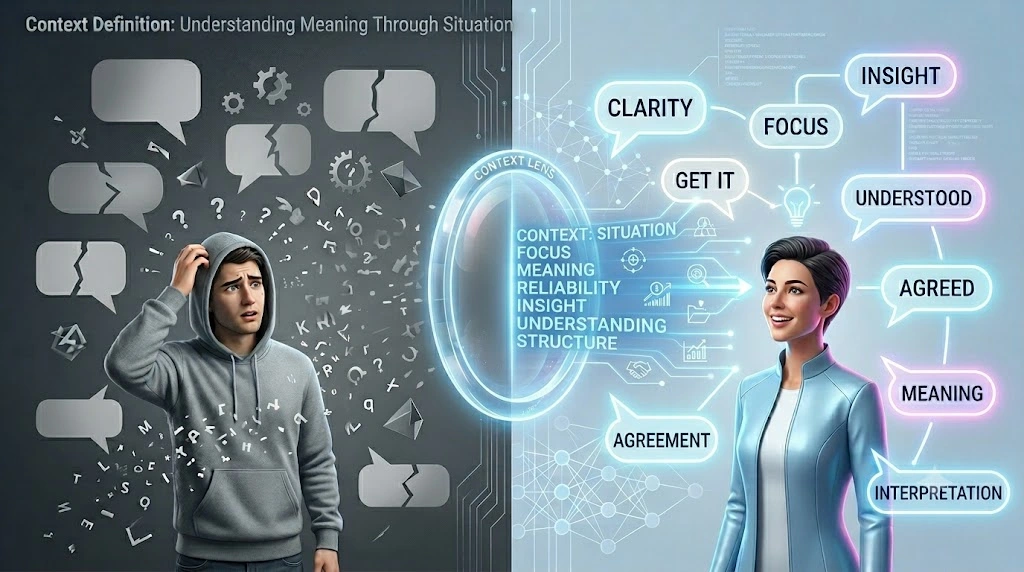
What is Context Definition?
Context definition refers to understanding the meaning of a word, sentence, idea, or message by analyzing the situation in which it is used. Instead of focusing only on the literal meaning of words, context helps us interpret the intended meaning based on surrounding information.
In communication, context acts like a “background frame” that gives clarity to what is being said or written. Without context, messages can become incomplete, confusing, or even misleading.
For example, the word “light” can mean something not heavy, or it can refer to illumination. Only the context tells us which meaning is correct.
Context definition is widely used in linguistics, literature, education, psychology, and artificial intelligence because it ensures accurate interpretation of meaning.
Why Context Definition is Important
Context definition is not just a linguistic concept—it is essential for everyday understanding and communication.
One of the biggest reasons it matters is that meaning is not fixed. Words can change meaning depending on tone, situation, and intention. Context helps decode this hidden meaning.
It also plays a key role in preventing misunderstandings. Many arguments, misinterpretations, and confusion in daily life happen because people ignore context.
Another important aspect is that context improves communication accuracy. Whether in writing, speaking, or digital messaging, context ensures that the message is received as intended.
In education, context helps learners connect abstract concepts with real-life situations, making learning easier and more meaningful.
Types of Context in Definition (Expanded View)
Context exists in multiple layers, and each layer influences meaning differently.
Linguistic Context (Word-Based Meaning)
Linguistic context focuses on how words interact within sentences or paragraphs. It helps determine meaning based on grammar, structure, and surrounding words.
For example:
- “She went to the bank.”
Without context, “bank” is unclear. - “She went to the bank to withdraw money.”
Now the meaning is clear—it refers to a financial institution.
Linguistic context is especially important in:
- Reading comprehension
- Writing clarity
- Translation accuracy
- Language learning
Social Context (People & Relationships)
Social context refers to the relationship between speakers, cultural norms, and social environment.
The same sentence can mean different things depending on who says it and to whom.
For example:
- A friend saying “You’re crazy!” may sound playful.
- A boss saying the same words could sound offensive or unprofessional.
Social context includes:
- Age differences
- Cultural background
- Formal vs informal settings
- Power relationships
This makes it extremely important in real-world communication.
Situational Context (Time, Place & Environment)
Situational context refers to the physical or environmental situation in which communication happens.
For example:
- “It’s freezing!”
In winter, it refers to cold weather.
In a workplace, it could refer to air conditioning being too strong.
Situational context helps interpret:
- Time of conversation
- Physical location
- Current events or conditions
It is commonly used in storytelling, journalism, and daily conversation.
Emotional Context (Tone & Feeling)
Emotional context refers to the speaker’s mood, tone, or emotional state.
For example:
- “Great…”
This can mean happiness, sarcasm, frustration, or disappointment depending on tone.
Emotional context is very important in:
- Text messages
- Social media posts
- Spoken conversations
Without emotional cues, messages can easily be misread.
Context Definition in Real Life Communication
Context is used constantly in everyday life, even without realizing it.
Texting & Social Media Examples
Digital communication often lacks tone, so context becomes essential.
Example:
- “Okay.”
This could mean agreement, annoyance, or disinterest.
Without context, the receiver may misinterpret the intention.
Classroom & Learning Examples
Teachers use context to explain complex subjects.
For example:
- “Cell” in biology means a living unit.
- “Cell” in prison means a small room.
Context helps students understand the correct meaning based on subject.
Workplace Communication
In professional settings, context ensures clarity and avoids conflict.
Example:
- “We need to talk.”
This could mean a serious issue or a simple discussion depending on workplace situation.
Media & News Interpretation
News headlines often depend heavily on context.
A headline without full context may create misunderstanding or panic, even if the full article explains the situation clearly.
Common Problems When Context is Ignored
Ignoring context can lead to serious communication issues.
One major problem is misinterpretation of meaning. People may assume the wrong intention behind a message.
Another issue is overreaction. A harmless comment may seem offensive if context is missing.
It can also lead to conflict in relationships, especially in texting where tone is not visible.
In professional environments, lack of context can result in poor decision-making or misunderstanding instructions.
How to Improve Context Understanding Skills
Improving context understanding is essential for better communication.
1. Pay Attention to Full Message
Never judge meaning from a single word or phrase.
2. Understand Situation
Always consider where, when, and how something is said.
3. Identify Tone
Try to recognize whether the message is serious, humorous, or emotional.
4. Think Before Reacting
Pause and interpret meaning before responding emotionally.
5. Practice Reading & Observation
The more you read and observe communication patterns, the better your contextual understanding becomes.
Context Definition in Modern Digital World
In today’s world of social media, AI, and fast communication, context is more important than ever.
Short messages, emojis, and abbreviations often lack clarity without context. Even artificial intelligence systems rely heavily on context to generate accurate responses.
For example:
- “I’m fine 🙂” vs “I’m fine.”
The emoji changes the emotional context completely.
FAQs on Context Definition
1. What is the simple definition of context?
Context is the situation or environment in which something is said or written. It helps explain the true meaning of words or messages. Without context, meaning can become unclear or confusing.
2. Why is context important in communication?
Context is important because it helps people understand the correct meaning behind messages. It reduces misunderstandings and improves clarity in conversation. It also helps identify tone and intention.
3. What are the main types of context?
The main types of context include linguistic, social, situational, and emotional context. Each type affects how meaning is interpreted. Together, they help explain communication more clearly.
4. How does context change meaning?
Context changes meaning by providing background information about how a word or sentence is used. The same word can have different meanings in different situations. Context decides the correct interpretation.
5. What is linguistic context in simple words?
Linguistic context means the words and sentences around a word that help explain its meaning. It focuses on grammar and sentence structure. It ensures words are understood correctly.
6. What is social context in communication?
Social context refers to the relationship between people and the social situation in which communication happens. It affects tone, respect, and meaning. The same words can feel different depending on who says them.
7. What happens if context is ignored?
If context is ignored, messages can be misunderstood or taken the wrong way. It can lead to confusion, arguments, or wrong interpretations. Communication becomes less effective and unclear.
8. How is context used in daily life?
Context is used in daily conversations, texting, education, and workplace communication. It helps people understand jokes, sarcasm, and emotions. It is essential for clear understanding in every situation.
9. Can one word have different meanings based on context?
Yes, many words have multiple meanings depending on context. For example, “light” can mean not heavy or illumination. The situation decides the correct meaning.
10. How can I improve understanding of context?
You can improve by reading full messages, paying attention to tone, and observing situations carefully. Thinking before reacting also helps avoid misunderstanding. Practice makes contextual understanding stronger over time.
Conclusion
Context definition is a fundamental concept that explains how meaning depends on situation, language, and environment. It ensures accurate communication, reduces misunderstandings, and helps people interpret messages correctly.
From daily conversations to education, workplace communication, and digital media, context shapes how we understand everything around us. Without it, language would lose clarity and meaning would become uncertain.
Understanding context is not just a language skill—it is a communication skill that improves thinking, interpretation, and human interaction.