Why Everyone Is Suddenly Searching “TF Meaning”
If you’ve seen someone type “TF is this?” or “What TF happened?” and felt confused, you’re not alone. The abbreviation TF is one of the most widely used internet slang terms today, yet it still causes a lot of misunderstanding.
People search it because it appears everywhere—texts, TikTok comments, gaming chats, and even workplace messages. At first glance, it looks harmless, but its meaning can change depending on tone and context.
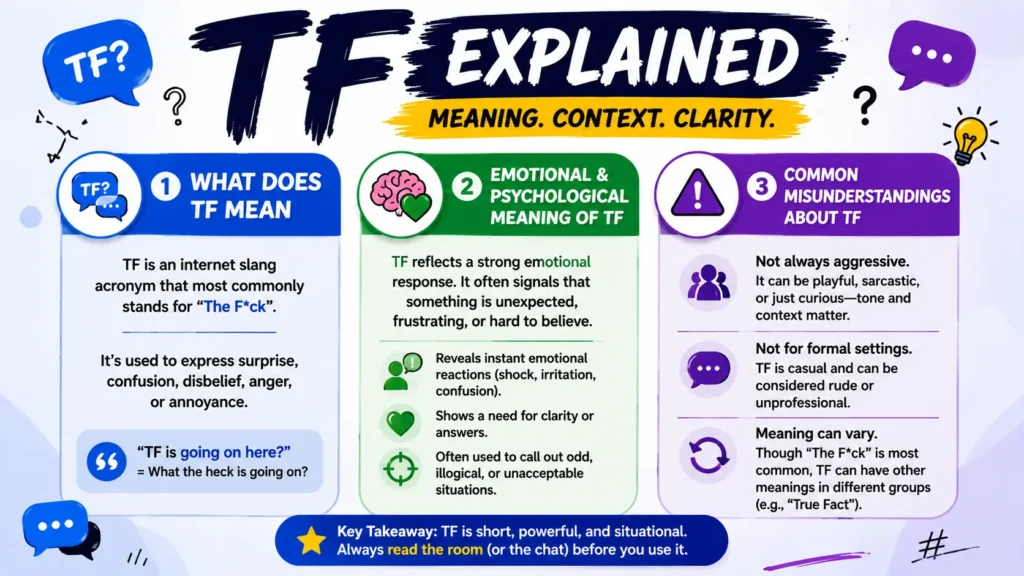
In simple terms, TF is a slang abbreviation used to express surprise, confusion, frustration, or emphasis. It often replaces a stronger word in casual conversation.
The confusion happens because TF doesn’t have just one meaning. It shifts based on situation, emotion, and platform.
TF Meaning – Quick Meaning
The abbreviation TF mainly stands for:
- “The F*” (informal expression used for emphasis or shock)**
- Used to show strong emotion like surprise or disbelief
- Common in texting, gaming, and social media
Examples:
- “TF is going on here?” → confusion
- “TF you mean?” → disbelief
- “TF happened last night?” → shock
It’s not always offensive, but it is considered informal and slightly rude depending on context.
Origin & Background of TF
The term TF comes from early internet chat culture, especially from gaming forums and early messaging platforms in the 2000s.
As online communication became faster and more expressive, people started shortening emotional phrases. Instead of typing full expressions, users began using abbreviations like OMG, WTF, and TF.
Social media platforms like Twitter (now X), TikTok, and Instagram accelerated its usage. Gamers especially popularized it because quick reactions were needed during gameplay.
Over time, TF evolved from a shock expression into a flexible slang word used for emphasis in almost any emotional sentence.
Real-Life Conversations Using TF (MANDATORY)
📱 WhatsApp Chat
Person A: Bro, I just saw your result
Person B: TF?? Don’t scare me like that 😭
Person A: Chill, you passed
📸 Instagram DM
Person A: Did you see her new look?
Person B: TF she looks unreal 🔥
Person A: I know right, glow up is crazy
🎵 TikTok Comments
User1: This edit is insane
User2: TF did I just watch 😭🔥
User3: Same, it’s too good
💬 Text Message
Person A: I lost my phone again
Person B: TF how do you keep doing that 💀
Emotional & Psychological Meaning of TF
TF is not just slang—it reflects strong emotional reactions in digital communication.
People use it because:
- It saves time during emotional reactions
- It expresses shock more naturally than full sentences
- It matches fast-paced online conversations
Psychologically, TF shows how modern communication is becoming more reactive than descriptive. Instead of explaining emotions, users react instantly.
Example scenario:
Imagine you wake up and see a message saying your class schedule changed overnight. Instead of writing a full sentence like “I’m shocked and confused,” most people simply type:
“TF is this??”
That instant reaction captures emotion more efficiently.
Usage in Different Contexts
📱 Social Media
Used in memes, reactions, and comments:
- “TF is this trend 💀”
💕 Friends & Relationships
Used casually between friends:
- “TF you doing bro?”
💼 Work / Professional Settings
Rare and not recommended. Can seem unprofessional:
- Avoid using TF in emails or formal chats
🎮 Gaming / Casual Tone
Very common in gaming reactions:
- “TF was that move??”
When NOT to Use TF
Even though TF is popular, it’s not always appropriate.
Avoid using it:
- In formal emails or job communication
- With elders or authority figures
- In academic writing
- In sensitive emotional conversations
It can sometimes sound rude or aggressive depending on tone.
Common Misunderstandings About TF
Many people misunderstand TF because of its flexible meaning.
1. Literal Confusion
Some think TF is a technical term, but it’s not.
2. Tone Misreading
“TF you doing?” can sound playful or aggressive depending on delivery.
3. Overuse in Serious Topics
Using TF in serious situations can seem disrespectful.
Comparison Table
| Term | Meaning Intent | Usage Intent | Example Intent | Comparison Insight |
|---|---|---|---|---|
| TF | Strong reaction/emphasis | Informal expression | “TF is this?” | Emotional slang |
| WTF | Shock + stronger tone | More intense reaction | “WTF happened?” | Stronger than TF |
| OMG | Surprise/excitement | Neutral reaction | “OMG that’s cute” | Less aggressive |
| huh | Confusion | Mild reaction | “Huh?” | Softer than TF |
| what the heck | Polite shock | Friendly tone | “What the heck!” | Cleaner version |
Key Insight:
TF sits in the middle of emotional slang—stronger than casual words like “huh,” but less extreme than “WTF.”
Variations / Types of TF (8–10 examples)
1. TF meaning in text
Used for shock or confusion in messaging.
2. TF slang meaning
Internet slang expressing strong emotion.
3. TF abbreviation
Short form of emotional reaction phrase.
4. TF in chat
Used in casual conversations for emphasis.
5. TF meaning Gen Z
Reaction-based slang used in memes and TikTok.
6. TF meaning in Roblox
Used during gameplay frustration or surprise.
7. TF meaning in business
Rare, but may mean “Task Force” in professional settings.
8. TF meaning in medical terms
Often refers to “Tissue Factor” in biology.
9. TF meaning in money
Not standard, but sometimes confused with financial abbreviations.
10. TF meaning in charts
Can refer to “time frame” in data or trading charts.
How to Respond When Someone Uses TF
😄 Casual replies
- “I know right 😭”
- “Same reaction!”
😂 Funny replies
- “Bro said TF like a scientist 💀”
- “Mood honestly”
🧠 Mature replies
- “Yeah, that’s unexpected.”
- “I understand your reaction.”
🙏 Respectful replies
- “Let me explain what happened.”
- “I’ll clarify it for you.”
Regional & Cultural Usage of TF
🌍 Western Culture
Common in memes, gaming, and casual texting.
🌏 Asian Culture
Used heavily among Gen Z on TikTok and messaging apps.
🕌 Middle Eastern Culture
Used informally among youth but avoided in formal settings.
💻 Global Internet Usage
Universal slang understood across platforms.
👶 Generational Differences
- Gen Z: Very frequent use
- Millennials: Understand but use less
- Older generations: Often confused
Is TF Safe for Kids?
TF is generally considered informal slang and may include implied strong language. While not harmful in itself, it is not recommended for younger children due to its tone and association with mild profanity. Parents often prefer kids to use cleaner alternatives like “what” or “oh my gosh.”
FAQs (5–7 Questions)
What is TF in furry slang?
In furry slang, TF usually stands for “Transformation,” which refers to characters changing form, often into animals or fantasy creatures. It is commonly used in storytelling, roleplay, and creative communities. The meaning is very different from texting slang and is specific to transformation-based content.
What does TF mean in LOL?
In League of Legends (LOL), TF commonly refers to the champion “Twisted Fate,” a popular mid-lane character known for card-based abilities. Players often use “TF” when discussing strategies, builds, or gameplay involving him. It is not slang here but a character abbreviation.
What is the full form of TF in Gen Z?
For Gen Z, TF does not have a single official full form, but it is widely understood as shorthand for “the f,” used to express shock or emphasis. It is mostly used in casual texting, memes, and social media reactions. The meaning depends heavily on tone and context.
Is TF always considered slang?
TF is not always slang because its meaning changes across contexts like gaming, science, and casual texting. In professional or academic fields, it may stand for technical terms such as “Tissue Factor” or “Transcription Factor.” So its interpretation depends entirely on where it is used.
Can TF be used in formal conversations?
TF is generally not suitable for formal communication because it carries informal and sometimes offensive undertones. In workplaces or academic writing, it is better to use clear and respectful language instead. Using TF in serious settings may be seen as unprofessional or disrespectful.
Why do people use TF instead of full words?
People use TF because it is short, expressive, and fits the fast pace of digital conversations. It allows users to quickly show strong emotions like confusion or surprise without typing full sentences. This makes it popular in texting, gaming, and social media interactions.
What does TF mean in texting?
TF is slang used to show surprise, confusion, or strong emotional reaction in casual chats.
Is TF a bad word?
It’s not fully a bad word, but it is informal and may imply strong language depending on context.
What does TF mean on social media?
On platforms like TikTok or Instagram, it expresses shock, disbelief, or humor.
Can TF be used professionally?
No, it is not appropriate for formal or workplace communication.
What does TF mean in Gen Z slang?
Gen Z uses TF as a quick reaction word in memes and fast-paced conversations.
Is TF the same as WTF?
Not exactly. WTF is stronger and more intense, while TF is slightly softer.
Why do people use TF instead of full sentences?
Because it’s faster, expressive, and fits modern short-form communication styles.
Conclusion
TF is more than just an abbreviation; it represents how digital communication has evolved into fast, emotional, and expressive language. People use it to react instantly to shocking or confusing situations without typing full sentences. While it is popular in texting, gaming, and social media, it should be avoided in formal contexts. Understanding TF helps you read online conversations more clearly and respond naturally. In modern slang, it reflects attitude, emotion, and the speed of internet culture today.