If you have ever received a text saying “IDT so” or “IDT that’s right,” you may have paused and wondered what it actually means. In today’s fast-moving digital world, abbreviations have become a major part of online communication, and IDT is one of those short expressions that appears across texting apps, social media platforms, and online chats.
People search for “IDT meaning in text” because the acronym can have different meanings depending on the situation. While it often stands for a simple opinion or disagreement, it can also represent technical, educational, healthcare, military, and business terms. Understanding the context is the key to interpreting it correctly.
This guide explains every major meaning of IDT, where it came from, how people use it in everyday conversations, and how to respond confidently when you see it.
IDT Meaning in Text – Quick Meaning
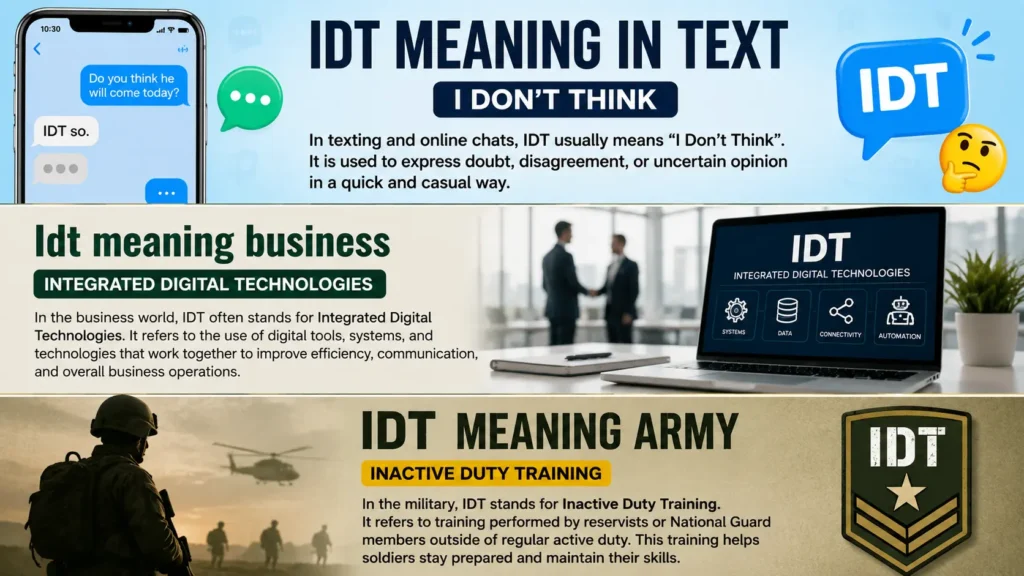
In texting and social media conversations, IDT usually means “I Don’t Think.”
It is commonly used when expressing doubt, disagreement, uncertainty, or a personal opinion.
Examples:
- “IDT that’s a good idea.”
- “IDT he will come today.”
- “IDT anyone noticed the mistake.”
Quoted examples:
“IDT she’s upset, just tired.”
“IDT we need to worry yet.”
“IDT that’s what they meant.”
The phrase helps people communicate quickly while keeping messages short and casual.
Origin & Background
The abbreviation IDT emerged during the rise of internet chat rooms, SMS texting, and instant messaging platforms in the early 2000s. Mobile phones often had character limits, encouraging users to shorten common phrases.
As social media platforms evolved, acronyms like LOL, BRB, IMO, and IDT became part of everyday online language. Users wanted faster communication without typing complete sentences.
The popularity of messaging apps such as WhatsApp, Snapchat, Instagram, and TikTok further expanded the use of IDT. Today, it remains a common shorthand among younger internet users and frequent texters.
Over time, IDT evolved from a simple texting abbreviation into a term that also appears in professional industries such as healthcare, education, military services, and business operations.
IDT Meaning in Text in Urdu
In Urdu, the texting meaning of IDT (“I Don’t Think”) can be translated as:
“Mujhe nahi lagta”
or
“Mera khayal nahi hai”
Examples:
- IDT he will come.
- Mujhe nahi lagta woh aaye ga.
- IDT this is correct.
- Mujhe nahi lagta yeh sahi hai.
Many bilingual users switch between English abbreviations and Urdu conversations, making IDT common in Pakistani and South Asian texting culture.
IDT Meaning Snapchat
On Snapchat, IDT almost always means “I Don’t Think.”
Snapchat conversations are fast, casual, and often filled with abbreviations. Users frequently use IDT when responding to questions, sharing opinions, or reacting to stories.
Examples:
- “IDT that’s your best picture.”
- “IDT she’ll reply today.”
- “IDT anyone noticed my snap.”
The tone is usually informal and conversational.
IDT Meaning Business
In business environments, IDT may refer to Integrated Digital Technologies, Instructional Design Team, or other organization-specific terms.
Examples include:
- Integrated Digital Technology departments.
- Internal Development Teams.
- Information Delivery Technology systems.
Because business acronyms vary by company, employees should always confirm the intended meaning within their workplace.
IDT Meaning in Healthcare
In healthcare, IDT commonly stands for Interdisciplinary Team.
An Interdisciplinary Team consists of healthcare professionals working together to provide comprehensive patient care.
Typical members include:
- Doctors
- Nurses
- Therapists
- Social workers
- Care coordinators
Healthcare organizations use IDT meetings to discuss patient treatment plans and improve outcomes through collaboration.
IDT Meaning in School
In educational settings, IDT may refer to:
- Instructional Design Technology
- Integrated Design and Technology
- Individual Development Training
The exact meaning depends on the school, college, or educational program.
Students often encounter IDT as a course title, department name, or academic specialization.
IDT Meaning Army
Within military contexts, IDT often means Inactive Duty Training.
Inactive Duty Training refers to scheduled training periods completed by reserve military personnel outside active-duty service.
Examples include:
- Weekend drills
- Training exercises
- Professional development sessions
Military members frequently use the acronym when discussing training schedules and reserve obligations.
IDT Meaning Urban Dictionary
According to common internet slang interpretations often discussed online, IDT primarily means “I Don’t Think.”
Urban slang communities generally recognize it as a quick way to express uncertainty, disagreement, or skepticism.
Example:
- “IDT that’s happening.”
- “IDT you’re serious.”
The meaning remains largely consistent across social media platforms.
IDT Meaning Mental Health
In mental health and healthcare settings, IDT often refers to an Interdisciplinary Team working together to support patients.
Mental health IDTs may include:
- Psychiatrists
- Psychologists
- Counselors
- Nurses
- Social workers
The collaborative approach helps ensure patients receive well-rounded care addressing emotional, psychological, and practical needs.
Real-Life Conversations
WhatsApp Conversation
Person A:
Are you coming to the party tonight?
Person B:
IDT so. I still have work to finish.
Person A:
That’s okay. Let me know if things change.
Instagram DM
Person A:
Do you think that rumor is true?
Person B:
IDT it is. People online exaggerate everything.
Person A:
Yeah, that’s probably right.
TikTok Comments
Person A:
This trend will disappear next week.
Person B:
IDT. It’s getting more popular every day.
Person A:
We’ll see what happens.
Text Message
Person A:
Do you think he likes me?
Person B:
IDT he’s ignoring you on purpose. He’s probably busy.
Person A:
That makes me feel better.
Emotional & Psychological Meaning
Although IDT appears simple, it often carries emotional nuance.
People use it when they:
- Feel uncertain
- Want to disagree politely
- Avoid sounding overly confident
- Express skepticism
- Protect someone’s feelings
Rather than saying “You’re wrong,” a person may say “IDT that’s correct.” The softer wording reduces conflict and maintains social harmony.
Imagine a friend asking whether they failed an interview. Instead of giving a harsh answer, you might respond, “IDT you should worry yet.” The phrase communicates support while acknowledging uncertainty.
This reflects a broader trend in modern communication where people seek efficiency without sacrificing emotional sensitivity.
Usage in Different Contexts
Social Media
IDT appears frequently on Snapchat, Instagram, TikTok, X, and Facebook. Users often share opinions or reactions quickly using the abbreviation.
Friends & Relationships
Among friends, IDT softens disagreement and creates a casual conversational tone.
Example:
“IDT you’re being fair.”
Work & Professional Settings
In professional communication, spelling out “I don’t think” is usually preferred for clarity and professionalism.
However, IDT may still appear in internal team chats.
Casual vs Serious Tone
Casual:
“IDT that’s a problem.”
Serious:
“I don’t think this approach aligns with our objectives.”
The full phrase often sounds more professional than the abbreviation.
When NOT to Use It
Avoid using IDT in:
- Formal business emails
- Academic papers
- Legal documents
- Official reports
- Professional presentations
It can also create confusion when communicating with people unfamiliar with internet slang.
In multicultural environments, abbreviations may not translate clearly and could lead to misunderstandings.
Common Misunderstandings
Several misunderstandings occur with IDT.
Assuming Everyone Knows It
Not all users recognize texting abbreviations, especially older generations.
Confusing Industry Meanings
Healthcare workers may interpret IDT as Interdisciplinary Team, while texters see it as I Don’t Think.
Misreading Tone
A simple “IDT” can sound dismissive if the reader cannot hear vocal tone.
Literal vs Figurative Usage
Sometimes IDT expresses uncertainty rather than actual disagreement.
Example:
“IDT that’s true” may simply mean the person lacks enough information.
Comparison Table
| Term | Meaning / Intent |
|---|---|
| What Does IDT Mean | Understand the definition of the acronym |
| How to Use IDT | Learn when and where to apply it |
| Examples of IDT | See real-world conversations and situations |
| IDT vs IMO | IDT expresses doubt; IMO expresses opinion |
| IDT vs IDC | IDT means uncertainty; IDC means indifference |
| IDT vs IKR | IDT disagrees or doubts; IKR agrees strongly |
| IDT vs TBH | IDT questions something; TBH introduces honesty |
Key Insight
The power of IDT comes from its ability to express disagreement gently. Rather than creating conflict, it allows users to share opinions while remaining conversational and approachable.
Variations / Types
IDT meaning
Most commonly means “I Don’t Think.”
IDT in text
Used to express doubt, uncertainty, or disagreement.
IDT abbreviation
A shortened form of “I Don’t Think.”
IDT slang
Popular internet slang used in chats and social media.
IDT in chat
Common in casual conversations and messaging apps.
IDTS meaning
Usually means “I Don’t Think So.”
IDTK meaning
Means “I Don’t Know.”
IDC meaning
Means “I Don’t Care.”
IMO meaning
Means “In My Opinion.”
TBH meaning
Means “To Be Honest.”
How to Respond When Someone Uses It
Casual Replies
- “Maybe you’re right.”
- “We’ll find out soon.”
- “Good point.”
Funny Replies
- “Your detective skills are showing.”
- “Let’s ask the internet.”
- “Bold prediction.”
Mature Replies
- “That’s a reasonable perspective.”
- “I understand why you think that.”
- “Let’s look at the facts.”
Respectful Replies
- “Thanks for sharing your opinion.”
- “I appreciate your honesty.”
- “That’s helpful to know.”
Regional & Cultural Usage
Western Culture
IDT is widely recognized among social media users and younger generations.
Asian Culture
Many users combine English abbreviations with local languages, making IDT common in multilingual chats.
Middle Eastern Culture
Young internet users frequently use IDT alongside Arabic and English mixed conversations.
Global Internet Usage
The abbreviation has become part of universal internet language due to social media’s global reach.
Gen Z vs Millennials
Gen Z tends to use abbreviations more frequently and naturally. Millennials understand IDT but may use complete phrases more often in conversation.
Is It Safe for Kids?
Yes. IDT itself is generally safe and harmless because it simply means “I Don’t Think” in most texting situations.
Parents should still encourage children to understand context, as abbreviations can occasionally have different meanings in specialized industries or communities.
FAQs
What does IDTS mean in texting?
IDTS stands for “I Don’t Think So” and is commonly used when someone politely disagrees or expresses doubt about something. It is a slightly stronger version of IDT because it gives a more definite response. People often use it in casual chats, social media comments, and text conversations.
Is IDT a slang word?
Yes, IDT is considered internet slang and texting shorthand for “I Don’t Think.” It became popular through SMS messaging, online chat rooms, and social media platforms where users wanted to type faster. Today, it is widely understood among younger internet users.
How do you use IDT in a sentence?
IDT is usually placed at the beginning of a sentence to show uncertainty or disagreement. For example, someone might write, “IDT that’s the best option” or “IDT he knows about it yet.” The abbreviation keeps messages short while still expressing an opinion clearly.
What does IDT mean on Instagram?
On Instagram, IDT generally means “I Don’t Think” and is often seen in comments, captions, and direct messages. Users employ it when sharing opinions, reacting to posts, or responding to questions. The meaning is usually casual and depends on the conversation context.
What is the difference between IDT and IDC?
IDT means “I Don’t Think” and expresses doubt, uncertainty, or disagreement about something. IDC stands for “I Don’t Care” and indicates a lack of concern or interest in a topic. While IDT shares an opinion, IDC shows indifference.
Why do people use IDT instead of typing the full phrase?
People use IDT because it saves time and makes digital conversations faster and more convenient. Short abbreviations are especially popular on messaging apps where quick replies are common. It also helps maintain the informal tone that many online conversations have.
What does IDT mean in texting?
IDT usually stands for “I Don’t Think” and is used to express doubt or disagreement.
What does IDT mean on Snapchat?
On Snapchat, IDT typically means “I Don’t Think” in casual conversations.
Is IDT positive or negative?
It is usually neutral. The tone depends on the surrounding conversation.
Can IDT be used professionally?
It is better to avoid abbreviations in formal professional communication.
What does IDTS mean?
IDTS generally means “I Don’t Think So.”
Is IDT common among Gen Z?
Yes, Gen Z frequently uses IDT in texting and social media interactions.
Does IDT have multiple meanings?
Yes. Besides texting slang, it can refer to healthcare, education, military, and business terms.
Conclusion
Understanding the IDT meaning in text helps you navigate modern digital conversations with confidence. While it most commonly stands for “I Don’t Think,” its meaning can change depending on the context, especially in healthcare, education, business, and military settings. The abbreviation reflects how modern communication values speed, simplicity, and emotional nuance. Whether you’re chatting with friends, scrolling through social media, or encountering professional terminology, recognizing the context behind IDT ensures clearer communication and fewer misunderstandings in everyday interactions.