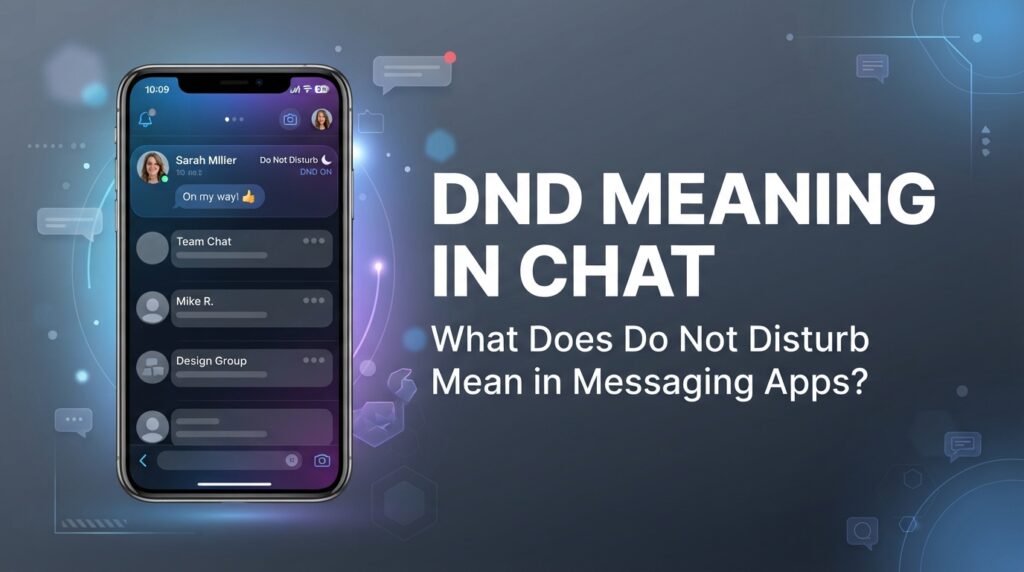
If you’ve ever received a message and noticed someone mentioning DND, or seen a moon icon on their profile, you may have wondered what it actually means. The DND meaning in chat is one of the most searched texting terms because it appears across messaging apps, smartphones, gaming platforms, and social media.
Although DND usually stands for “Do Not Disturb,” its meaning can vary depending on the conversation. Sometimes it simply means someone doesn’t want notifications. Other times, it politely signals that they’re busy, sleeping, studying, working, or just taking a break from constant messages.
Understanding what DND means helps you avoid misunderstandings, respect other people’s boundaries, and communicate more effectively online. In this guide, you’ll learn its meaning, origin, real-life examples, emotional context, and how people use it across different platforms.
DND Meaning in Chat – Quick Meaning
In chat, DND stands for Do Not Disturb. It tells others that someone doesn’t want to be interrupted by calls, messages, or notifications for a period of time.
Common meanings include:
- Busy working
- Sleeping or resting
- Studying
- Driving
- Taking personal time
- Avoiding distractions
Examples
“Sorry, I’m on DND until my meeting ends.”
“Put your phone on DND if you’re studying.”
“He’s on DND tonight, so he probably won’t reply.”
The phrase isn’t rude—it simply communicates that someone may respond later instead of immediately.
Origin & Background
The phrase Do Not Disturb existed long before smartphones. Hotels used “Do Not Disturb” signs on room doors so guests wouldn’t be interrupted.
As technology evolved, computer operating systems adopted similar notification settings. Eventually smartphones introduced Do Not Disturb Mode, allowing users to silence calls, texts, and alerts without turning off their phones.
Social media and messaging apps helped popularize the abbreviation DND, making it part of everyday internet language. Today, millions of people use it casually in chats without even spelling out the full phrase.
The rise of remote work, online classes, and digital wellness has also made DND more important than ever, encouraging healthier boundaries with technology.
Real-Life Conversations
Person A: Are you free to talk?
Person B: I’m on DND while working. I’ll message you after lunch.
Instagram DMs
Person A: Why didn’t you see my Reel?
Person B: My phone stayed on DND all evening.
TikTok Comments
Person A: Why are you replying so late?
Person B: My phone was on DND and I completely missed the notifications.
Text Messages
Person A: I called twice.
Person B: Sorry! I keep DND on while sleeping.
Emotional & Psychological Meaning
Although DND looks like a simple phone setting, it often reflects something deeper.
People use DND because they want focus, peace, privacy, or emotional space. Constant notifications can create stress, anxiety, and distraction, so activating DND is often an act of self-care rather than avoidance.
For example, imagine preparing for an important exam. Instead of checking messages every few minutes, you switch on DND to stay focused. Friends might think you’re ignoring them, but in reality you’re protecting your concentration.
In today’s always-connected world, DND has become a healthy digital boundary instead of a sign of rejection.
Usage in Different Contexts
Social Media
People mention DND in captions, stories, or bios to let followers know they may reply later.
Example:
“On DND today. Catch you tomorrow!”
Friends & Relationships
Friends often say they’re on DND when studying, working, or relaxing.
In relationships, it helps avoid unnecessary misunderstandings by explaining delayed replies.
Work & Professional Settings
Professionals use DND during meetings, presentations, client calls, or focused work sessions.
Example:
“I’ll be on DND from 2–4 PM during training.”
Casual vs Serious Tone
Casually, DND simply means “I’m busy.”
In serious situations, it can communicate a need for personal space, mental rest, or uninterrupted time.
DND Meaning in Love
In relationships, DND usually still means “Do Not Disturb,” but the emotional meaning depends on the situation. Someone may turn on DND to focus on work, sleep peacefully, or enjoy personal time without constant notifications. In a healthy relationship, this is often a sign of setting boundaries rather than ignoring a partner.
However, if someone repeatedly claims to be on DND while remaining active elsewhere, it may naturally raise questions about communication. The best approach is to avoid assumptions and have an honest conversation instead of interpreting DND as rejection. Trust and clear communication matter more than a phone setting.
DND Meaning in Chat in English
The DND meaning in chat in English is simply “Do Not Disturb.” It tells others that a person is temporarily unavailable or prefers not to receive interruptions. It doesn’t necessarily mean they won’t read messages—it usually means notifications are silenced or they plan to reply later.
People commonly use DND in texting, WhatsApp, Messenger, Discord, Telegram, and other messaging apps. It’s become a universal internet abbreviation that signals availability without needing a long explanation.
What Does DND Mean on Phone
On smartphones, DND (Do Not Disturb) is a feature that silences incoming calls, messages, and app notifications while allowing the device to remain powered on. Unlike Airplane Mode, your phone stays connected to mobile networks and Wi-Fi.
Most modern phones also let users customize DND by allowing emergency contacts, repeated callers, alarms, or favorite people to bypass the silence. This makes it useful for sleeping, studying, working, driving, or attending meetings without unnecessary distractions.
What Does DND Mean TikTok
On TikTok, DND usually refers to someone putting their phone on Do Not Disturb so they can avoid notifications while watching videos, creating content, or taking a break from messages.
Creators often joke about turning on DND to binge-watch TikTok for hours without interruptions. Others mention DND when they don’t immediately respond to comments or direct messages. In most cases, it isn’t TikTok-specific slang—it simply keeps its original “Do Not Disturb” meaning.
DND Meaning in Chat Reddit
On Reddit, discussions about DND meaning in chat almost always agree that it stands for Do Not Disturb. Users frequently mention enabling DND to improve focus, reduce stress, or avoid being constantly available online.
Some Reddit conversations also discuss how DND can affect relationships, with people sharing experiences about delayed replies and digital boundaries. The overall consensus is that DND is a practical communication tool rather than a sign that someone is intentionally ignoring others.
DND Meaning in Chat Funny
The internet loves creating humorous meanings for common abbreviations, and DND is no exception. While the real meaning remains Do Not Disturb, friends often invent playful interpretations.
Funny examples include:
- Definitely Not Doing Anything
- Do Not Date
- Do Nut Disturb 🍩
- Dreaming, Not Deciding
- Don’t Nag Daily
These jokes are meant for entertainment and aren’t the official meaning. Context usually makes it obvious when someone is being playful.
DND Meaning in Instagram
On Instagram, DND typically means the user has enabled Do Not Disturb on their phone or simply wants uninterrupted time away from notifications.
People may write things like:
- “On DND today.”
- “Replies will be slow—phone’s on DND.”
- “Weekend = DND mode.”
This lets followers know delayed responses are intentional and not personal. It also reflects the growing trend of maintaining healthier digital habits.
DND Mode Meaning
DND Mode refers to the actual Do Not Disturb feature available on smartphones, tablets, computers, smartwatches, and some messaging platforms. When enabled, it limits interruptions by silencing notifications while allowing important alerts if the user chooses.
Modern DND modes often include features such as:
- Scheduled quiet hours
- Sleep mode integration
- Focus modes
- Work profiles
- Driving mode
- Emergency contact exceptions
Instead of disconnecting from the internet, DND simply reduces distractions while keeping the device fully functional.
When NOT to Use It
Although DND is widely understood, there are situations where mentioning it may create confusion or seem insensitive.
- Don’t use it as an excuse for repeatedly avoiding important conversations.
- Avoid saying “I’m on DND” during emergencies when immediate communication matters.
- Don’t assume everyone understands the abbreviation, especially in formal or international settings.
- In professional emails, writing “I’m currently unavailable” is often clearer than using DND.
- If someone is expecting an urgent response, explain your availability instead of relying only on the abbreviation.
Using DND thoughtfully helps maintain trust while respecting both your own time and other people’s expectations.
Common Misunderstandings
Many people misunderstand what DND actually means, leading to unnecessary confusion.
| Misunderstanding | Reality |
|---|---|
| DND means someone is ignoring me. | It usually means notifications are silenced. |
| DND blocks all communication. | Messages still arrive—they’re simply muted. |
| DND is only for smartphones. | Computers, smartwatches, and apps also support DND. |
| DND is rude. | It’s generally considered a respectful way to set boundaries. |
| DND always means sleeping. | It can also mean working, studying, driving, or relaxing. |
Key Insight
DND isn’t about avoiding people—it’s about managing attention. In today’s digital world, respecting someone’s DND status is often a sign of respecting their time, focus, and well-being.
Comparison Table
| Search Intent | Meaning |
|---|---|
| What Does DND Mean? | Learn that DND stands for Do Not Disturb and indicates someone doesn’t want interruptions. |
| How to Use DND | Use it when you’re busy, sleeping, studying, working, driving, or need uninterrupted time. |
| Examples of DND | “I’m on DND until my meeting ends.” “My phone was on DND all night.” |
| DND vs AFK | DND means notifications are silenced, while AFK (Away From Keyboard) means the person is temporarily away from their device. |
Key Insight
While abbreviations like AFK, BRB, and OOO all indicate some form of unavailability, DND specifically focuses on preventing interruptions rather than showing physical absence. Understanding this difference helps avoid misinterpreting someone’s intentions.
Variations / Types of DND (10 Examples)
1. DND Meaning
DND stands for Do Not Disturb and signals that someone doesn’t want interruptions.
2. DND in Text
In text messages, DND lets others know replies may be delayed because notifications are muted.
3. DND Abbreviation
DND is the widely accepted abbreviation for Do Not Disturb across devices and messaging apps.
4. DND Slang
As internet slang, DND casually means “I’m unavailable right now.”
5. DND in Chat
In chats, DND politely explains why someone isn’t responding immediately.
6. DND on WhatsApp
People often mention DND when they mute notifications while still receiving messages.
7. DND on Instagram
Instagram users may say they’re on DND to explain slower replies to DMs.
8. DND on TikTok
TikTok creators use DND when avoiding distractions while creating or watching content.
9. DND Phone Mode
This refers to the built-in device feature that silences calls, alerts, and notifications.
10. DND Status
Some apps display a DND status so friends know the user prefers not to be disturbed.
How to Respond When Someone Uses DND
Casual Replies
- “No worries, reply whenever you’re free.”
- “Take your time!”
- “I’ll message you later.”
Funny Replies
- “Your phone deserves a vacation too. 😂”
- “I’ll wait until DND retires.”
- “Guess your notifications are on holiday.”
Mature Replies
- “Hope everything goes well. Reach out when you can.”
- “I understand. We’ll talk later.”
- “Take care of what you need first.”
Respectful Replies
- “Thanks for letting me know.”
- “I’ll respect your quiet time.”
- “Looking forward to hearing from you later.”
Regional & Cultural Usage
Western Culture
In North America and Europe, DND is commonly associated with productivity, work-life balance, and digital wellness. People openly use it to set healthy boundaries.
Asian Culture
Many users activate DND during study sessions, work hours, or family gatherings. Respecting uninterrupted time is often considered courteous.
Middle Eastern Culture
DND is generally understood as a practical phone setting, though people may provide additional explanations during important family or social occasions.
Global Internet Usage
Across the internet, DND has become a universal abbreviation recognized on nearly every major messaging platform, regardless of language.
Gen Z vs Millennials
Gen Z frequently mentions DND in captions, memes, and social media posts as part of digital self-care. Millennials tend to use it more functionally for work, parenting, meetings, and managing daily responsibilities.
Is It Safe for Kids?
Yes. DND is generally safe and appropriate for children because it simply means Do Not Disturb. Parents often encourage kids to use DND while studying, sleeping, or focusing on homework. However, children should also understand when to disable DND so they don’t miss important calls or emergency notifications.
Frequently Asked Questions
What does DND mean in texting?
In texting, DND stands for “Do Not Disturb.” It usually means the sender has silenced their phone notifications or is temporarily unavailable because they’re working, studying, sleeping, or taking a break. Seeing DND in a conversation doesn’t mean you’re being ignored—it simply lets you know that a reply may come later when the person is available.
What does DND mean for girls?
For girls, DND has the same meaning as it does for everyone else: Do Not Disturb. It often indicates that they need uninterrupted time for work, school, rest, or personal space rather than signaling a negative emotion. The meaning depends on the context, so it’s best not to assume someone is upset just because they’ve enabled DND or mentioned it in chat.
What is DND in social media?
On social media platforms like Instagram, TikTok, Snapchat, and WhatsApp, DND refers to Do Not Disturb and tells others that notifications are muted or replies may be delayed. Many users also mention DND in captions, bios, or stories to explain why they aren’t responding immediately. It’s become a common way to communicate healthy digital boundaries while staying connected online.
What is DND in Messenger?
In Facebook Messenger, DND generally refers to muting notifications so incoming messages don’t create alerts or sounds. Messages are still delivered normally, but the user won’t be interrupted until they check the app or disable Do Not Disturb mode. This feature is especially useful during meetings, sleep, study sessions, or other times when uninterrupted focus is important.
Does DND block messages or calls?
No, DND does not block messages or calls in most cases—it simply silences the notifications associated with them. The messages and missed calls are still received and can be viewed later when the user checks their device. Many phones also allow emergency contacts or repeated callers to bypass DND if needed.
Why do people turn on DND instead of turning off their phone?
People prefer Do Not Disturb because it reduces distractions without disconnecting them from the internet or mobile network. They can still receive important messages, alarms, and selected calls while avoiding constant notification sounds. This makes DND an ideal feature for balancing productivity, relaxation, and communication without completely switching off their device.
What does DND mean in chat?
DND means Do Not Disturb. It tells others that someone is temporarily unavailable or has silenced notifications and may reply later.
Does DND mean someone is ignoring me?
Not necessarily. Most people use DND to reduce distractions while working, studying, sleeping, or taking personal time, not to avoid specific individuals.
What does DND do on a phone?
It silences calls, texts, and app notifications while keeping the phone connected. Many phones also allow alarms and important contacts to bypass DND.
Is DND the same as Airplane Mode?
No. Airplane Mode disconnects wireless connections like cellular service and Wi-Fi, while DND only silences notifications without disconnecting your phone.
Can I still receive messages on DND?
Yes. Messages still arrive normally, but your phone usually won’t alert you until DND is turned off or exceptions are allowed.
Why do people use DND on social media?
People use DND to focus, protect their mental well-being, avoid constant notifications, and let others know that delayed replies aren’t personal.
Is using DND considered rude?
Generally, no. When used honestly, DND is viewed as a respectful way to set boundaries and manage your availability.
Conclusion
The DND meaning in chat is much more than a simple abbreviation for Do Not Disturb. It has become a modern way of communicating availability, protecting focus, and maintaining healthy digital boundaries. Whether you see it in text messages, WhatsApp, Instagram, TikTok, or on your phone, DND usually signals that someone wants uninterrupted time—not that they’re ignoring you. Understanding its context helps prevent misunderstandings, encourages respectful communication, and allows you to use the term confidently in both personal and professional conversations.